
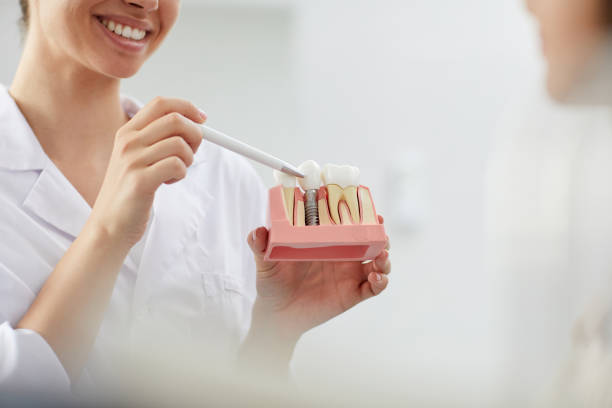
A single-tooth dental implant replaces one missing tooth with a fixture placed in the jawbone and a custom dental crown connected to it. This replacement stands independently, rather than relying on neighboring teeth to support a conventional bridge. At Dental Design Studio in Modesto, CA, we help patients understand how the implant, its connection, and the final crown work together to restore the missing tooth.
Whether your tooth was recently removed or the space has been there for years, the starting point is the same: evaluating the gap, the bone beneath it, and the teeth around it. That examination helps determine whether an implant-supported crown is appropriate and what treatment would involve for you.
What Is a Single-Tooth Dental Implant?
A single-tooth dental implant is a fixed replacement for one missing tooth. Its support comes from an implant in the jawbone, so the teeth on either side generally do not need to be reshaped to hold the replacement in place.
The completed restoration usually has three main components:
- Implant fixture: The part placed in the jawbone, where it provides the foundation for the replacement tooth.
- Abutment or restorative connection: The component that connects the fixture to the crown above it.
- Dental crown: The visible, tooth-shaped restoration used for biting and chewing.
People often call this entire system an implant, but the fixture alone is not a complete tooth replacement. The crown finishes the restoration, and its design is considered from the beginning of treatment. The goal is to position the foundation where it can support a tooth that fits the space and works with your bite.
How Does an Implant Replace the Root of a Missing Tooth?
The implant fixture serves as an artificial foundation in the area where the missing tooth’s root once provided support. It is positioned within the jawbone rather than resting on the gums or hanging from neighboring teeth.
At placement, the fixture needs adequate initial stability. During healing, bone develops a close connection with the implant surface through a process called osseointegration. That connection provides the support needed for the planned crown.
An implant takes over an important supporting role, but it does not recreate every biological feature of a natural root. For example, it does not have the same periodontal ligament that surrounds a natural tooth root. Its connection to the bone is different, which is one reason the bite and restoration need careful planning.
How Does the Implant Crown Replace the Visible Tooth?
The crown replaces the part of the tooth you see above the gumline. Your dentist plans its size, shape, shade, and position in relation to the surrounding smile.
A crown also needs to function within the available space. Its chewing surface must meet the opposing teeth appropriately, and its contacts with neighboring teeth must be checked. The way it fits beside the gums matters for both appearance and cleaning.
Once the implant is ready for restoration, the crown is attached through an abutment or other restorative connection. The attachment design varies, but its purpose is consistent: connecting the replacement tooth to its foundation in the jawbone.
Why Replace One Missing Tooth With a Dental Implant?
Replacing a missing tooth may improve chewing, fill a visible gap, and help maintain relationships between the surrounding teeth. A single implant offers a way to do that without making adjacent teeth carry the replacement.
That does not mean every missing tooth needs an implant. The location of the gap, condition of the remaining teeth, bite, health history, and your preferences all influence the recommendation. An examination helps establish what replacing that particular tooth would accomplish.
Restoring Chewing Function After Tooth Loss
A missing tooth can leave an area where the upper and lower teeth no longer meet as intended. You may notice that food is harder to chew there or that you favor the other side of your mouth.
An implant-supported crown restores a chewing surface in the gap. Its shape and position are planned so that it works with the opposing teeth rather than simply filling the visible space. Your dentist checks the bite when the crown is fitted and may make adjustments to its contacts.
An implant can provide a stable replacement, although it may not feel exactly like the natural tooth you lost. Comfort and function depend on the whole restoration and the conditions around it.
Helping Maintain Tooth Position and Bite Alignment
When a tooth is missing, neighboring teeth may tilt or drift toward the gap. An opposing tooth can also move farther into the open space, a change sometimes called over-eruption. These changes do not occur at the same speed or to the same extent for everyone.
Replacing the missing tooth may help maintain the space and support the planned bite relationship. However, a crown cannot automatically move teeth back into their former positions.
If movement has already reduced the available room, your dentist needs to account for it before planning the implant. Sometimes additional treatment is needed to create appropriate space for the replacement tooth.
Supporting the Jawbone Around the Missing Tooth
The jawbone changes after tooth loss. The ridge that supported the tooth can become narrower or lose height, affecting the foundation available for future replacement.
An implant transfers functional forces into the surrounding bone and can help maintain bone around the implant. It does not completely prevent bone remodeling or protect the entire jaw from bone loss.
The practical question is whether there is enough bone to place the implant in the right position for the crown. Imaging and an examination help answer that question; the appearance of the gap alone cannot show the condition of the bone beneath it.
Replacing the Tooth Without Relying on Neighboring Teeth
A single implant supports its own crown. Unlike a conventional tooth-supported bridge, it generally does not require neighboring healthy teeth to be reduced and covered with supporting crowns.
That distinction can be especially relevant when the teeth beside the gap are intact. The dentist can replace the missing tooth while preserving those teeth’s structure for support purposes.
Independent support does not mean the neighboring teeth are ignored. Their roots, gum health, position, and contact with the planned crown still affect treatment. They may also need separate care if they have decay or damage. A bridge remains a reasonable option in some situations, particularly when those teeth already need crowns.
How Is a Single-Tooth Implant Different From a Dental Bridge?
The main difference is where the replacement gets its support. A single-tooth implant uses a fixture in the jawbone. A conventional bridge uses supporting natural teeth beside the gap.
| Attribute | Single-Tooth Implant | Conventional Dental Bridge |
|---|---|---|
| Support | Implant placed in the jawbone | Adjacent supporting natural teeth |
| Neighboring Teeth | Generally do not need preparation for support | Supporting teeth usually need preparation |
| Replacement Structure | Implant, connection, and individual crown | Replacement tooth joined to supporting crowns |
| Surgery | Implant placement required | Typically no implant surgery |
| Bone Relationship | Implant engages the bone at the missing-tooth site | No implant placed in the missing-tooth site |
| Treatment Time | Includes time for implant healing | Often shorter, depending on preparation needed |
Both options can replace a missing tooth with a restoration that stays in the mouth. The most suitable choice depends on the support available, treatment complexity, and your priorities. This comparison refers to a conventional bridge; other bridge designs have different requirements.
When Might a Dental Bridge Be a Better Option?
A bridge may be appropriate if you prefer to avoid implant surgery, implant placement is not clinically suitable, or the neighboring teeth already need crowns. The amount of preparatory treatment needed for an implant may also influence your decision.
Time and finances matter, too. A bridge may offer a shorter route to a fixed replacement in some cases, while an implant requires healing before completion. Those differences should be discussed alongside the condition of the supporting teeth and expected maintenance.
For patients exploring alternatives to surgery, dental bridges supported by neighboring teeth are another restorative option worth discussing. Your consultation should help you understand why either treatment fits your situation.
What Is the Process for Replacing One Missing Tooth With an Implant?
Single-tooth treatment connects two tasks: establishing a foundation in the jawbone and creating the crown that foundation will support. Planning both together helps the completed tooth fit the space, surrounding gums, and bite.
The sequence depends on your starting condition. A recently damaged tooth that still needs removal presents different planning questions from a gap that has been healed for years.
Step 1: Evaluating the Missing Tooth and Jawbone
Your dentist examines the missing-tooth site, neighboring teeth, gum condition, and bite. The evaluation also considers the position of nearby roots and the room available for the crown, including the space between the upper and lower teeth.
Dental imaging helps assess bone and nearby anatomy. Three-dimensional imaging is used for implant planning to provide information that cannot be obtained from looking at the gums alone. Your dentist selects the imaging needed for the clinical situation and considers existing records.
Medical history, medications, and habits such as smoking or grinding are also reviewed. You can discuss what bothers you about the missing tooth and what you hope treatment will change. The resulting plan should explain the proposed foundation and the final replacement tooth.
Step 2: Preparing the Implant Site When Necessary
Some sites are ready for implant placement after evaluation. Others need preparation first.
If a damaged tooth is still present, your dentist must determine whether it can be preserved or needs extraction. When removal is necessary, the condition of the socket and surrounding tissues helps guide implant timing.
Bone grafting may be considered if the site lacks sufficient support. Active oral infection or periodontal disease also needs management as part of planning. These are individual decisions; having one missing tooth does not automatically mean you need grafting or another surgical procedure before placement.
Ask which preparatory steps are necessary in your case and how they affect the overall sequence.
Step 3: Placing the Dental Implant in the Jawbone
The fixture is surgically positioned according to the planned crown and available bone. Appropriate anesthesia is used, and the approach is selected for the site and your treatment needs.
The implant must have sufficient initial stability for the chosen healing plan. Your dentist then provides instructions for caring for the area, limiting pressure when necessary, and attending follow-up visits.
Placement establishes the foundation, but it does not automatically mean the tooth replacement is finished. The next steps depend on healing, stability, and whether any temporary restoration is appropriate. Follow the instructions given for your procedure rather than assuming you can chew normally as soon as soreness improves.
Step 4: Allowing the Implant to Integrate With Bone
During osseointegration, the bone forms a connection with the implant surface. The time needed depends on the site, any additional procedures, and your healing response.
Your dentist evaluates the implant and surrounding tissues before moving forward with the final restoration. A comfortable gumline alone does not confirm that the implant is ready for the same forces as a completed replacement tooth.
Follow-up appointments help determine when to proceed. If the treatment schedule changes, ask what the examination showed and what needs to happen before the crown can be completed. Healing is assessed clinically rather than by a single deadline that applies to everyone.
Step 5: Attaching the Final Dental Implant Crown
Once the foundation is ready, the restorative phase creates the visible tooth. Records of the implant position, neighboring teeth, and bite are used to make a crown suited to the space.
An abutment or other connection joins the finished crown to the fixture. Your dentist checks the fit, contacts with neighboring teeth, appearance, and the way the crown meets the opposing teeth. Adjustments may be needed before treatment is complete.
The crown’s shape should also allow practical cleaning around the restoration. Your team can show you how to reach the spaces beside it. For a closer look at this stage, read how the final crown attaches to a dental implant.
Can a Dental Implant Replace a Missing Front Tooth or Molar?
Yes. A single implant may replace a front tooth or a back tooth, but the planning priorities differ. A front-tooth replacement is highly visible, while a molar replacement needs particular attention to chewing forces and available space.
In either location, the implant and crown are planned together. The tooth’s position affects both its appearance and the demands placed on its foundation.
Replacing a Missing Front Tooth With an Implant
For a front tooth, matching the neighboring teeth involves more than choosing a shade. Crown shape, width, position, and the way the restoration emerges from the gumline all influence the result.
Your dentist also evaluates the gum contours and underlying bone. These tissues help frame the tooth, so deficiencies can affect appearance even when the crown itself is carefully made. The position of neighboring teeth and how much gum shows when you smile also matter.
If you are concerned about having a visible gap during treatment, bring that up early. Temporary replacement options can be discussed while the longer-term plan is developed. A natural-looking outcome is the goal, but the starting condition influences what treatment can achieve.
Replacing a Missing Back Tooth With an Implant
A molar crown needs a chewing surface suited to its location and the opposing teeth. Its material, contours, and bite contacts are considered alongside the support available beneath it.
The dentist evaluates the width of the gap, space between the jaws, and bone height and width. Nearby anatomy matters as well, including the sinus in the upper jaw and nerve location in the lower jaw.
Clenching or grinding may influence restorative planning and protective recommendations. Not every missing molar requires an implant, and the loss of a wisdom tooth usually presents a different situation from losing a functional first molar. The recommendation should explain the role that particular tooth plays in your bite.
Who Is a Good Candidate for a Single-Tooth Dental Implant?
A suitable single-tooth site needs enough support and space for an implant and its crown. The dentist also considers gum health, neighboring teeth, bite, medical history, and your ability to maintain the area.
Smoking and some health conditions can affect healing or long-term risk. These factors require individual assessment rather than an assumption that everyone with the same diagnosis has the same options.
Jaw growth also matters when considering implants for younger patients. A missing adult tooth does not, by itself, mean the timing is right for an implant. A consultation can establish whether treatment is appropriate now or whether another approach is needed.
Can You Get an Implant if the Tooth Has Been Missing for Years?
Yes, it may still be possible. The number of years alone does not determine eligibility.
Over time, bone may change and the teeth around the gap may move. Your dentist needs to assess the space available for both the fixture and the crown, including whether an opposing tooth has moved into the gap.
Some patients can proceed with a relatively straightforward plan. Others need bone development, management of existing disease, or treatment to address tooth position first. If you have assumed the gap is too old to treat, an evaluation can replace that uncertainty with information about your actual options.
What if There Is Not Enough Bone for a Single-Tooth Implant?
Bone grafting may help develop a site that cannot currently support an implant in an appropriate position. Whether it is suitable depends on the location and extent of the deficiency, surrounding anatomy, and overall treatment plan.
Some grafts can be performed with implant placement; others need a separate healing period. Grafting is not a guarantee of success or a requirement for every patient.
Our guide to bone grafting before dental implant placement explains this supporting treatment in more detail. Your dentist can clarify whether it is needed for your single-tooth site.
Can You Get an Implant Immediately After a Tooth Extraction?
Immediate implant placement is possible in selected cases. It means placing the fixture during the same appointment as extraction, rather than waiting for the socket to heal first.
The decision depends on the remaining bone, tissue condition, infection assessment, tooth location, and whether adequate implant stability can be achieved. It is not appropriate for every extraction site.
Immediate placement is also different from immediately attaching a tooth or allowing normal chewing on it. A temporary restoration may be possible under specific conditions, but receiving the implant on extraction day does not promise a final crown that day. Ask separately about placement timing and when the replacement can be used.
How Long Does It Take to Replace One Tooth With a Dental Implant?
Single-tooth implant treatment commonly involves several months from placement through healing and completion of the crown. The entire course may take longer when extraction, site healing, or grafting is needed first.
A useful estimate separates the stages: preparation, implant placement, integration, and the restorative appointments. This makes it easier to understand what is happening between visits and why a gap in the appointment schedule may be part of healing.
Someone with a healed site and adequate bone may have a different sequence from someone with a recently infected tooth or significant bone deficiency. Your dentist should explain the anticipated timeline and the findings that could change it.
The aim is to complete the crown when its foundation is ready, rather than choose a date that ignores healing.
Can You Have a Temporary Tooth While the Implant Heals?
Often, a temporary replacement can be considered, particularly when the missing tooth is visible. The appropriate option depends on the site, bite, implant stability, and any restrictions during healing.
A temporary tooth may be provided through a removable appliance or another provisional design. In selected situations, it can be supported by the implant. These choices are not interchangeable, and a temporary tooth may have limits on biting and chewing.
Discuss appearance, work, and daily eating concerns before treatment starts. Your dentist can explain what is possible and how to protect the healing area. A temporary restoration should not be mistaken for a promise of a same-day final implant crown.
How Much Does a Single-Tooth Dental Implant Cost in Modesto?
The cost depends on the complete treatment needed to replace your tooth, not just the fixture placed in the bone. An individual examination is necessary for a meaningful estimate.
When reviewing dental implant costs, ask which of these are included:
- Examination and imaging: Assessing the site and planning the replacement.
- Implant fixture and placement: The foundation and the procedure to position it.
- Abutment or restorative connection: The component joining the fixture and crown.
- Final crown: Fabrication, fitting, and attachment of the replacement tooth.
- Site preparation: Extraction, bone grafting, or other procedures if required.
- Temporary replacement and follow-up: Clarifying what is included and what may have a separate fee.
Ask for the estimate to identify the anticipated stages and any services that depend on later findings. If you are comparing proposals, check whether they cover the same completed restoration; a fixture-only price cannot be compared directly with a full treatment estimate.
Insurance benefits vary by plan, so confirm applicable coverage and your expected responsibility. If affordability is a concern, say so during the consultation. Understanding the full plan and available alternatives is more useful than trying to judge treatment from an advertised starting price.
Is a Single-Tooth Implant More Expensive Than a Bridge?
It can be, particularly when implant treatment includes additional site preparation. However, the comparison depends on the procedures and restorations included in each plan.
A bridge estimate may include preparation and coverage of supporting teeth, while an implant estimate includes surgical and restorative components. Both can involve future maintenance or replacement costs.
Ask for comparable, complete estimates and an explanation of how the neighboring teeth affect the recommendation. Neither option can be promised to cost less over your lifetime, because future care needs vary.
How Do You Care for a Single-Tooth Dental Implant?
Clean an implant-supported tooth every day and keep regular professional maintenance appointments. Brush and clean between the crown and neighboring teeth using the method your dental team recommends.
An implant crown cannot develop a cavity, but plaque can still collect around it. The surrounding gums can become inflamed, and disease can affect the bone supporting the fixture. The neighboring natural teeth remain vulnerable to decay and gum disease as well.
Ask for a cleaning demonstration if you struggle to reach the area. Professional visits check tissue health, the crown and its connection, and the bite. The recommended schedule depends on your needs and history.
Report looseness, a changed bite, persistent discomfort, swelling, or recurring bleeding. A moving crown does not automatically mean the implant has failed, but it needs prompt assessment. Do not try to tighten or repair it yourself.
How Long Can a Single-Tooth Dental Implant Last?
A single-tooth implant is intended as a long-term replacement, but it does not come with a universal lifespan. Bone and tissue health, oral hygiene, general health, bite forces, and ongoing maintenance all influence its condition.
The fixture and crown also do different jobs. The fixture may remain stable while the crown needs adjustment, repair, or replacement because of wear or damage. Replacing a crown does not automatically require removing the implant beneath it.
Regular care helps identify changes and maintain both the foundation and the visible tooth. Your dentist can discuss the risks relevant to you without promising that any part will last for life.
Missing One Tooth? Take the First Step Toward a Complete Smile in Modesto
Whether you recently lost a tooth or have lived with a gap for years, you can start by finding out what the area needs. At Dental Design Studio, Dr. Rimmie Pandher and our team place and restore implants in our office. We can evaluate the space, explain how an implant-supported crown would work, and discuss alternatives such as a bridge.
Explore single-tooth dental implant treatment in Modesto with a plan based on your bone support, neighboring teeth, and bite. Scheduling a consultation can help you understand your options, anticipated treatment stages, and costs before deciding how to move forward.
Frequently Asked Questions About Single-Tooth Dental Implants
Can one dental implant replace one missing tooth?
Yes. One implant commonly supports one replacement crown. The fixture sits in the jawbone, and an abutment or restorative connection links it to the crown. An examination determines whether the site has appropriate support and space for this approach.
Do the teeth next to an implant need to be filed down?
Usually not for support. A single implant carries its own crown, so adjacent teeth generally do not need the preparation required for a conventional bridge. Neighboring teeth still need evaluation and may require separate treatment if they have existing problems.
Can I replace a missing molar with a dental implant?
It may be possible. Your dentist assesses available bone, space, nearby anatomy, and the forces on the planned crown. The recommendation depends on that molar’s role in your bite and your overall treatment needs rather than its location alone.
Can I get a single-tooth implant if my tooth has been missing for years?
Potentially, yes. Long-term tooth loss may change the bone and allow surrounding teeth to move, but it does not automatically prevent implant treatment. An evaluation establishes whether additional preparation is needed and whether an implant-supported crown can fit appropriately.
How long does it take to get a single dental implant?
Treatment generally includes planning, placement, healing, and the final crown, often over several months. Extraction or grafting can add stages. Your dentist can estimate the sequence for your site and explain when healing will be reassessed before moving forward.
Does a single-tooth implant look like a natural tooth?
The crown is designed to blend with nearby teeth through its shade, shape, size, and position. Gum contours and bone support also influence the result, especially for front teeth. Your dentist can discuss the appearance achievable from your starting condition.
Is a single-tooth implant better than a bridge?
Neither is best for everyone. An implant offers independent support, while a bridge may suit someone who wants to avoid surgery or whose adjacent teeth already need crowns. Bone support, treatment complexity, preferences, time, and costs all affect the decision.
How much does replacing one tooth with an implant cost?
The total depends on the examination, imaging, fixture and placement, connection, crown, and any necessary preparatory treatment. Temporary replacement and follow-up arrangements should also be clarified. Request a complete individual estimate so you know what is included before comparing options.
